This Brave New World Will Be Born Again
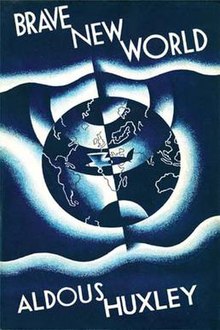 First edition cover by Leslie Holland | |
| Author | Aldous Huxley |
|---|---|
| Country | United Kingdom |
| Genre | Scientific discipline fiction, dystopian fiction |
| Published | Chatto & Windus |
| Publication engagement | 1932 |
| Pages | 311 (1932 ed.) 63,766 words[1] |
| OCLC | 20156268 |
Brave New Earth is a dystopian social science fiction novel past English language author Aldous Huxley, written in 1931 and published in 1932. Largely set in a futuristic Earth State, whose citizens are environmentally engineered into an intelligence-based social hierarchy, the novel anticipates huge scientific advancements in reproductive applied science, slumber-learning, psychological manipulation and classical conditioning that are combined to make a dystopian society which is challenged past only a single private: the story's protagonist. Huxley followed this book with a reassessment in essay grade, Brave New World Revisited (1958), and with his final novel, Island (1962), the utopian counterpart. The novel is frequently compared to George Orwell's Nineteen Lxxx-Iv (published 1949).
In 1999, the Modern Library ranked Brave New World at number five on its list of the 100 best English-language novels of the 20th century.[2] In 2003, Robert McCrum, writing for The Observer, included Dauntless New World chronologically at number 53 in "the top 100 greatest novels of all time",[3] and the novel was listed at number 87 on The Large Read survey by the BBC.[4] Despite this, Dauntless New Globe has ofttimes been banned and challenged since its original publication. Information technology has landed on the American Library Association listing of height 100 banned and challenged books of the decade since the association began the list in 1990.[five] [6] [7]
Championship [edit]
The title Brave New World derives from Miranda's speech in William Shakespeare'southward The Tempest, Act 5, Scene I:[eight]
O wonder!
How many goodly creatures are there here!
How beauteous mankind is! O brave new globe,
That has such people in't.—William Shakespeare, The Tempest, Act V, Scene I, ll. 203–206[9]
Shakespeare's apply of the phrase is intended ironically, as the speaker is failing to recognise the evil nature of the island'due south visitors because of her innocence.[10] Indeed, the next speaker replies to Miranda'south innocent observation with the argument "They are new to thee..."
Translations of the championship often allude to similar expressions used in domestic works of literature: the French edition of the work is entitled Le Meilleur des mondes (The Best of All Worlds), an allusion to an expression used past the philosopher Gottfried Leibniz[11] and satirised in Candide, Ou fifty'Optimisme by Voltaire (1759).
History [edit]
Huxley wrote Dauntless New World while living in Sanary-sur-Mer, French republic, in the four months from May to Baronial 1931.[12] [13] [fourteen] Past this time, Huxley had already established himself as a writer and social satirist. He was a contributor to Vanity Off-white and Vogue magazines, and had published a collection of his poetry (The Burning Cycle, 1916) and four successful satirical novels: Crome Yellow (1921), Antic Hay (1923), Those Barren Leaves (1925), and Point Counter Signal (1928). Brave New World was Huxley'south fifth novel and commencement dystopian work.
A passage in Crome Yellow contains a brief pre-figuring of Brave New World, showing that Huxley had such a future in mind already in 1921. Mr. Scogan, one of the earlier book's characters, describes an "impersonal generation" of the future that will "accept the identify of Nature'southward hideous arrangement. In vast land incubators, rows upon rows of gravid bottles volition supply the world with the population it requires. The family system will disappear; gild, sapped at its very base of operations, will have to find new foundations; and Eros, beautifully and irresponsibly gratis, will flit similar a gay butterfly from blossom to flower through a sunlit world."
Huxley said that Brave New World was inspired by the utopian novels of H. G. Wells, including A Modernistic Utopia (1905), and Men Similar Gods (1923).[fifteen] Wells's hopeful vision of the futurity's possibilities gave Huxley the thought to begin writing a parody of the novels, which became Brave New World. He wrote in a letter to Mrs. Arthur Goldsmith, an American acquaintance, that he had "been having a fiddling fun pulling the leg of H. K. Wells", but then he "got caught up in the excitement of [his] ain ideas."[xvi] Unlike the about pop optimistic utopian novels of the time, Huxley sought to provide a frightening vision of the future. Huxley referred to Brave New Globe as a "negative utopia", somewhat influenced by Wells's own The Sleeper Awakes (dealing with subjects like corporate tyranny and behavioural workout) and the works of D. H. Lawrence.[17] For his part Wells published, two years after Brave New World, his ain Utopian Shape of Things to Come. Seeking to refute the argument of Huxely'southward Mustafa Mond - that moronic underclasses were a necessary "social gyroscope" and that a society composed solely of intelligent, assertive "Alphas" would inevitably disintegrate is internecine struggle - Wells depicted a stable egalitarian society emerging after several generations of a reforming elite having complete control of education throughout the globe. In the future depicted in Wells' volume, posterity remembers Huxley equally "a reactionary author".[18]
The scientific futurism in Brave New Earth is believed to be appropriated from Daedalus [19] by J. B. S. Haldane.[20]
The events of the Depression in the U.k. in 1931, with its mass unemployment and the abandonment of the golden currency standard, persuaded Huxley to assert that stability was the "primal and ultimate demand" if civilisation was to survive the nowadays crisis.[21] The Dauntless New World character Mustapha Mond, Resident Earth Controller of Western Europe, is named subsequently Sir Alfred Mond. Shortly earlier writing the novel, Huxley visited Mond's technologically advanced establish nigh Billingham, north east England, and it made a great impression on him.[21] : xxii
Huxley used the setting and characters in his science fiction novel to express widely felt anxieties, particularly the fright of losing private identity in the fast-paced earth of the futurity. An early trip to the The states gave Brave New World much of its character. Huxley was outraged by the civilization of youth, commercial cheeriness, and sexual promiscuity, and the inward-looking nature of many Americans;[22] he had also found the book My Life and Work by Henry Ford on the boat to America, and he saw the book's principles applied in everything he encountered later leaving San Francisco.[21] : viii
Plot [edit]
The novel opens in the Globe State city of London in AF (Subsequently Ford) 632 (AD 2540 in the Gregorian calendar), where citizens are engineered through bogus wombs and childhood indoctrination programmes into predetermined classes (or castes) based on intelligence and labour. Lenina Crowne, a hatchery worker, is popular and sexually desirable, but Bernard Marx, a psychologist, is non. He is shorter in stature than the average member of his high caste, which gives him an inferiority complex. His work with sleep-learning allows him to understand, and disapprove of, his society'due south methods of keeping its citizens peaceful, which includes their constant consumption of a soothing, happiness-producing drug called Soma. Courting disaster, Bernard is song and arrogant nearly his criticisms, and his boss contemplates exiling him to Iceland because of his nonconformity. His only friend is Helmholtz Watson, a gifted author who finds it difficult to apply his talents creatively in their pain-free club.
Bernard takes a holiday with Lenina outside the Earth State to a Savage Reservation in New Mexico, in which the 2 observe natural-built-in people, affliction, the ageing process, other languages, and religious lifestyles for the first time. The civilisation of the village folk resembles the gimmicky Native American groups of the region, descendants of the Anasazi, including the Puebloan peoples of Hopi and Zuni.[23] Bernard and Lenina witness a violent public ritual and so encounter Linda, a adult female originally from the World State who is living on the reservation with her son John, now a young man. She, also, visited the reservation on a holiday many years agone, just became separated from her group and was left backside. She had meanwhile become meaning by a fellow-holidaymaker (who is revealed to be Bernard's dominate, the Director of Hatcheries and Workout). She did not endeavour to return to the Globe State, because of her shame at her pregnancy. Despite spending his whole life in the reservation, John has never been accepted past the villagers, and his and Linda's lives have been hard and unpleasant. Linda has taught John to read, although from the only book in her possession—a scientific manual and another volume John found: the complete works of Shakespeare. Ostracised past the villagers, John is able to articulate his feelings only in terms of Shakespearean drama, quoting ofttimes from The Tempest, King Lear, Othello, Romeo and Juliet and Hamlet. Linda now wants to return to London, and John, too, wants to see this "dauntless new world". Bernard sees an opportunity to thwart plans to exile him, and gets permission to take Linda and John back. On their return to London, John meets the Director and calls him his "father", a vulgarity which causes a roar of laughter. The humiliated Manager resigns in shame before he can follow through with exiling Bernard.
Bernard, as "custodian" of the "savage" John who is now treated every bit a celebrity, is fawned on by the highest members of guild and revels in attending he one time scorned. Bernard'due south popularity is fleeting, though, and he becomes envious that John simply really bonds with the literary-minded Helmholtz. Considered hideous and friendless, Linda spends all her time using soma, while John refuses to attend social events organised by Bernard, appalled by what he perceives to exist an empty society. Lenina and John are physically attracted to each other, simply John'southward view of courting and romance, based on Shakespeare'south writings, is utterly incompatible with Lenina'due south freewheeling attitude to sex. She tries to seduce him, but he attacks her, before of a sudden existence informed that his mother is on her deathbed. He rushes to Linda's bedside, causing a scandal, as this is not the "right" attitude to death. Some children who enter the ward for "expiry-conditioning" come across as disrespectful to John until he attacks one physically. He so tries to break up a distribution of soma to a lower-caste group, telling them that he is freeing them. Helmholtz and Bernard blitz in to stop the ensuing riot, which the police force quell past spraying soma vapor into the crowd.
Bernard, Helmholtz, and John are all brought before Mustapha Mond, the "Resident World Controller for Western Europe", who tells Bernard and Helmholtz that they are to exist exiled to islands for antisocial activity. Bernard pleads for a second chance, but Helmholtz welcomes the opportunity to be a true individual, and chooses the Falkland Islands equally his destination, believing that their bad weather condition volition inspire his writing. Mond tells Helmholtz that exile is actually a reward. The islands are full of the well-nigh interesting people in the globe, individuals who did non fit into the social model of the Earth State. Mond outlines for John the events that led to the present society and his arguments for a caste organization and social control. John rejects Mond's arguments, and Mond sums up John'due south views past claiming that John demands "the right to be unhappy". John asks if he may go to the islands besides, merely Mond refuses, saying he wishes to meet what happens to John adjacent.
Jaded with his new life, John moves to an abandoned hilltop lighthouse, virtually the village of Puttenham, where he intends to adopt a solitary ascetic lifestyle in order to purify himself of civilization, practising self-flagellation. This draws reporters and eventually hundreds of amazed sightseers, hoping to witness his baroque behaviour.
For a while information technology seems that John might be left alone, after the public's attention is fatigued to other diversions, but a documentary maker has secretly filmed John's self-flagellation from a distance, and when released the documentary causes an international sensation. Helicopters get in with more journalists. Crowds of people descend on John's retreat, demanding that he perform his whipping ritual for them. From one helicopter a young woman emerges who is implied to be Lenina. John, at the sight of a woman he both adores and loathes, whips at her in a fury and so turns the whip on himself, exciting the oversupply, whose wild behaviour transforms into a soma-fuelled orgy. The next morning John awakes on the basis and is consumed by remorse over his participation in the night's events.
That evening, a swarm of helicopters appears on the horizon, the story of terminal night's orgy having been in all the papers. The beginning onlookers and reporters to make it detect that John is dead. John, although madly in dear with Lenina, was non able to bear her promiscuity, and, being constantly disturbed by visitors, he had hanged himself.
Characters [edit]
Bernard Marx, a sleep-learning specialist at the Central London Hatchery and Conditioning Heart. Although Bernard is an Alpha-Plus (the upper class of the society), he is a misfit. He is unusually short for an Alpha; an alleged accident with alcohol in Bernard's blood-surrogate before his decanting has left him slightly stunted. Bernard's independence of mind stems more from his inferiority complex and depressive nature than from any depth of philosophical conviction. Unlike his fellow utopians, Bernard is often angry, resentful, and jealous. At times, he is besides cowardly and hypocritical. His conditioning is clearly incomplete. He doesn't enjoy communal sports, solidarity services, or promiscuous sexual activity. He doesn't even get much joy out of soma. Bernard is in love with Lenina but he doesn't like her sleeping with other men, even though "everyone belongs to everyone else". Bernard's triumphant return to utopian civilisation with John the Savage from the Reservation precipitates the downfall of the Director, who had been planning to exile him. Bernard'south triumph is brusque-lived; he is ultimately banished to an island for his non-conformist behaviour.
John, the illicit son of the Director and Linda, built-in and reared on the Savage Reservation ("Malpais") after Linda was unwittingly left behind by her errant lover. John ("the Savage" or "Mr. Vicious", every bit he is often called) is an outsider both on the Reservation—where the natives still practice marriage, natural birth, family life and religion—and the ostensibly civilised World State, based on principles of stability and happiness. He has read naught but the complete works of William Shakespeare, which he quotes extensively, and, for the well-nigh role, aptly, though his allusion to the "Brave New World" (Miranda's words in The Tempest) takes on a darker and bitterly ironic resonance equally the novel unfolds. John is intensely moral co-ordinate to a lawmaking that he has been taught by Shakespeare and life in Malpais but is also naïve: his views are as imported into his own consciousness every bit are the hypnopedic messages of World Land citizens. The admonishments of the men of Malpais taught him to regard his mother every bit a whore; but he cannot grasp that these were the same men who continually sought her out despite their supposedly sacred pledges of monogamy. Because he is unwanted in Malpais, he accepts the invitation to travel back to London and is initially astonished by the comforts of the Earth State. However, he remains committed to values that exist only in his poetry. He first spurns Lenina for failing to alive upwardly to his Shakespearean ideal and then the entire utopian club: he asserts that its technological wonders and consumerism are poor substitutes for individual liberty, homo dignity and personal integrity. After his mother'southward expiry, he becomes securely distressed with grief, surprising onlookers in the hospital. He and so withdraws himself from order and attempts to purify himself of "sin" (want), but is unable to do then. He finds himself gathering a lot of trouble for both his body and heed. He soon does not realize what is real or what is fake, what he does and what he does not do. Presently everything he thinks about or feels but becomes blurred and unrecognizable. Finally he hangs himself in despair.
Helmholtz Watson, a handsome and successful Alpha-Plus lecturer at the College of Emotional Engineering and a friend of Bernard. He feels unfulfilled writing endless propaganda doggerel, and the stifling conformism and philistinism of the Earth Country make him restive. Helmholtz is ultimately exiled to the Falkland Islands—a cold aviary for disaffected Blastoff-Plus non-conformists—after reading a heretical verse form to his students on the virtues of solitude and helping John destroy some Deltas' rations of soma post-obit Linda's decease. Dissimilar Bernard, he takes his exile in his footstep and comes to view information technology as an opportunity for inspiration in his writing.
Lenina Crowne, a young, beautiful fetus technician at the Central London Hatchery and Conditioning Centre. She is part of the 30% of the female population that are not freemartins (sterile women). Lenina is promiscuous and popular but somewhat quirky in her club: she had a four-calendar month relation with Henry Foster, choosing not to have sex with anyone just him for a catamenia of time. She is basically happy and well-conditioned, using soma to suppress unwelcome emotions, equally is expected. Lenina has a date with Bernard, to whom she feels ambivalently attracted, and she goes to the Reservation with him. On returning to civilisation, she tries and fails to seduce John the Savage. John loves and desires Lenina but he is repelled by her forwardness and the prospect of pre-marital sex, rejecting her as an "impudent strumpet". Lenina visits John at the lighthouse but he attacks her with a whip, unwittingly inciting onlookers to do the same. Her exact fate is left unspecified.
Mustapha Mond, Resident World Controller of Western Europe, "His Fordship" Mustapha Mond presides over ane of the ten zones of the Globe State, the global government prepare upward later on the cataclysmic Nine Years' State of war and dandy Economical Collapse. Sophisticated and adept-natured, Mond is an urbane and hyperintelligent abet of the World Country and its ethos of "Customs, Identity, Stability". Among the novel's characters, he is uniquely aware of the precise nature of the lodge he oversees and what information technology has given upwards to reach its gains. Mond argues that art, literature, and scientific freedom must be sacrificed to secure the ultimate utilitarian goal of maximising societal happiness. He defends the caste system, behavioural conditioning, and the lack of personal liberty in the World State: these, he says, are a price worth paying for achieving social stability, the highest social virtue because information technology leads to lasting happiness.
Fanny Crowne, Lenina Crowne's friend (they accept the same last name because merely x g last names are in use in a Globe State comprising two billion people). Fanny voices the conventional values of her degree and society, particularly the importance of promiscuity: she advises Lenina that she should have more than one human in her life because it is unseemly to concentrate on just 1. Fanny then, all the same, warns Lenina away from a new lover whom she considers undeserving, nonetheless she is ultimately supportive of the immature woman's attraction to the savage John.
Henry Foster, one of Lenina's many lovers, he is a perfectly conventional Alpha male, casually discussing Lenina's body with his coworkers. His success with Lenina, and his coincidental attitude about it, infuriate the jealous Bernard. Henry ultimately proves himself equally the ideal Earth State denizen, finding no backbone to defend Lenina from John's assaults despite having maintained an uncommonly longstanding sexual relationship with her.
Benito Hoover, another of Lenina's lovers. She remembers that he is especially hairy when he takes his clothes off.
The Director of Hatcheries and Conditioning (DHC), likewise known as Thomas "Tomakin" Grahambell, he is the ambassador of the Key London Hatchery and Conditioning Middle, where he is a threatening figure who intends to exile Bernard to Republic of iceland. His plans take an unexpected turn, nevertheless, when Bernard returns from the Reservation with Linda (see below) and John, a child they both realize is actually his. This fact, scandalous and obscene in the World Land, not because information technology was extramarital (which all sexual acts are), but because it was procreative, leads the Director to resign his post in shame.
Linda , John'due south mother, decanted as a Beta-Minus in the World State, originally worked in the DHC's Fertilizing Room, and subsequently lost during a storm while visiting the New United mexican states Savage Reservation with the Director many years earlier the events of the novel. Despite post-obit her usual precautions, Linda became pregnant with the Director's son during their time together and was therefore unable to return to the World State by the fourth dimension that she institute her fashion to Malpais. Having been conditioned to the promiscuous social norms of the Earth Land, Linda finds herself at one time pop with every human being in the pueblo (because she is open to all sexual advances) and also reviled for the aforementioned reason, seen as a whore by the wives of the men who visit her and by the men themselves (who come to her yet). Her merely comforts at that place are mescal brought by Popé as well as peyotl. Linda is drastic to return to the World State and to soma, wanting nothing more from her remaining life than condolement until death.
The Curvation-Community-Songster, the secular equivalent of the Archbishop of Canterbury in the World State society. He takes personal criminal offence when John refuses to nourish Bernard'southward party.
The Director of Crematoria and Phosphorus Reclamation, i of the many disappointed, important figures to attend Bernard's party.
The Warden, an Alpha-Minus, the talkative chief administrator for the New United mexican states Savage Reservation. He is blond, short, broad-shouldered, and has a booming vocalism.[24]
Darwin Bonaparte, a "big game photographer" (i.eastward. filmmaker) who films John flogging himself. Darwin Bonaparte became known for two works: "feely of the gorillas' wedding",[25] and "Sperm Whale'due south Dear-life".[25] He had already made a name for himself[26] merely still seeks more than. He renews his fame by filming the vicious, John, in his newest release "The Roughshod of Surrey".[27] His proper name alludes to Charles Darwin and Napoleon Bonaparte.
Dr. Shaw, Bernard Marx's dr. who consequently becomes the doc of both Linda and John. He prescribes a lethal dose of soma to Linda, which volition cease her respiratory system from operation in a bridge of one to ii months, at her own behest but not without protest from John. Ultimately, they all agree that it is for the best, since denying her this request would cause more trouble for Society and Linda herself.
Dr. Gaffney, Provost of Eton, an Upper School for high-caste individuals. He shows Bernard and John effectually the classrooms, and the Hypnopaedic Control Room (used for behavioural conditioning through sleep learning). John asks if the students read Shakespeare simply the Provost says the library contains only reference books because solitary activities, such as reading, are discouraged.
Miss Keate, Caput Mistress of Eton Upper School. Bernard fancies her, and arranges an assignation with her.[28]
Others [edit]
- Freemartins, women who have been deliberately made sterile past exposure to male person hormones during fetal development but however physically normal except for "the slightest trend to grow beards." In the book, government policy requires freemartins to form lxx% of the female person population.
Of Malpais [edit]
- Popé, a native of Malpais. Although he reinforces the behaviour that causes hatred for Linda in Malpais by sleeping with her and bringing her mescal, he nevertheless holds the traditional beliefs of his tribe. In his early on years John attempted to kill him, but Popé brushed off his endeavor and sent him fleeing. He gave Linda a copy of the Complete Works of Shakespeare. (Historically, Popé or Po'pay was a Tewa religious leader who led the Pueblo Revolt in 1680 against Spanish colonial rule.)
- Mitsima, an elderberry tribal shaman who also teaches John survival skills such as rudimentary ceramics (specifically coil pots, which were traditional to Native American tribes) and bow-making.
- Kiakimé, a native daughter who John brutal for, but is instead somewhen wed to some other boy from Malpais.
- Kothlu, a native male child with whom Kiakimé is wednesday.
Background figures [edit]
These are non-fictional and factual characters who lived before the events in this book, just are of notation in the novel:
- Henry Ford, who has become a messianic figure to the World Country. "Our Ford" is used in identify of "Our Lord", as a credit to popularising the use of the assembly line.
- Sigmund Freud, "Our Freud" is sometimes said in place of "Our Ford" because Freud'south psychoanalytic method depends implicitly upon the rules of classical workout,[ commendation needed ] and because Freud popularised the idea that sex is essential to human happiness. (It is also strongly implied that citizens of the Earth State believe Freud and Ford to exist the same person.)[29]
- H. Thou. Wells, "Dr. Wells", British writer and utopian socialist, whose volume Men Like Gods was a motivation for Brave New World. "All's well that ends Wells", wrote Huxley in his messages, criticising Wells for anthropological assumptions Huxley institute unrealistic.
- Ivan Petrovich Pavlov, whose conditioning techniques are used to train infants.
- William Shakespeare, whose banned works are quoted throughout the novel past John, "the Savage". The plays quoted include Macbeth, The Tempest, Romeo and Juliet, Hamlet, King Lear, Troilus and Cressida, Measure for Measure and Othello. Mustapha Mond also knows them because as a World Controller he has admission to a selection of books from throughout history, including the Bible.
- Thomas Robert Malthus, 19th century British economist, believed the people of the Earth would somewhen be threatened by their inability to raise enough food to feed the population. In the novel, the eponymous character devises the contraceptive techniques (Malthusian chugalug) that are skillful by women of the Globe State.
- Reuben Rabinovitch, the Polish-Jew character on whom the effects of slumber-learning, hypnopædia, are first observed.
- John Henry Newman, 19th century Catholic theologian and educator, believed university teaching the disquisitional chemical element in advancing mail-industrial Western culture. Mustapha Mond and The Savage talk over a passage from one of Newman'southward books.
- Alfred Mond, British industrialist, financier and pol. He is the namesake of Mustapha Mond.[30]
- Mustafa Kemal Atatürk, the founder and first President of Commonwealth of Turkey. Naming Mond after Atatürk links up with their characteristics, he reigned during the time Brave New Earth was written and revolutionised the 'old' Ottoman state into a new nation.[thirty]
Sources of names and references [edit]
The express number of names that the World Country assigned to its bottle-grown citizens can be traced to political and cultural figures who contributed to the bureaucratic, economical, and technological systems of Huxley's age, and presumably those systems in Brave New Globe.[31]
- Soma: Huxley took the proper noun for the drug used by the state to command the population afterward the Vedic ritual drinkable Soma, inspired by his interest in Indian mysticism.
- Malthusian belt: A contraceptive device worn by women. When Huxley was writing Dauntless New World, organizations such as the Malthusian League had spread throughout Europe, advocating contraception. Although the controversial economic theory of Malthusianism was derived from an essay by Thomas Malthus about the economical furnishings of population growth, Malthus himself was an advocate of forbearance rather than contraception.
Critical reception [edit]
Upon publication, Rebecca West praised Brave New World as "The virtually accomplished novel Huxley has yet written",[32] Joseph Needham lauded it as "Mr. Huxley'due south remarkable volume",[33] and Bertrand Russell also praised it, stating, "Mr. Aldous Huxley has shown his usual masterly skill in Dauntless New Globe."[34]
However, Brave New Globe also received negative responses from other gimmicky critics, although his piece of work was subsequently embraced.[35]
In an article in the 4 May 1935 event of the Illustrated London News, G. Grand. Chesterton explained that Huxley was revolting confronting the "Age of Utopias". Much of the discourse on man's future earlier 1914 was based on the thesis that humanity would solve all economic and social issues. In the decade post-obit the state of war the soapbox shifted to an examination of the causes of the catastrophe. The works of H. G. Wells and George Bernard Shaw on the promises of socialism and a Globe State were then viewed as the ideas of naive optimists. Chesterton wrote:
Later the Age of Utopias came what nosotros may call the American Historic period, lasting equally long equally the Blast. Men like Ford or Mond seemed to many to accept solved the social riddle and made capitalism the common skillful. Just it was not native to us; information technology went with a buoyant, not to say blatant optimism, which is not our negligent or negative optimism. Much more than Victorian righteousness, or even Victorian self-righteousness, that optimism has driven people into pessimism. For the Slump brought even more than disillusionment than the War. A new bitterness, and a new bewilderment, ran through all social life, and was reflected in all literature and fine art. It was contemptuous, non simply of the erstwhile Capitalism, but of the old Socialism. Brave New World is more than of a revolution against Utopia than against Victoria.[36]
Similarly, in 1944 economist Ludwig von Mises described Brave New World every bit a satire of utopian predictions of socialism: "Aldous Huxley was even courageous plenty to make socialism's dreamed paradise the target of his sardonic irony."[37]
Fordism and social club [edit]
The Globe Land is congenital upon the principles of Henry Ford's assembly line: mass production, homogeneity, predictability, and consumption of disposable consumer appurtenances. While the World State lacks whatever supernatural-based religions, Ford himself is revered as the creator of their society only not as a deity, and characters gloat Ford Twenty-four hour period and swear oaths by his name (e.1000., "Past Ford!"). In this sense, some fragments of traditional faith are present, such as Christian crosses, which had their tops cut off to be changed to a "T", representing the Ford Model T. In England, there is an Arch-Community-Songster of Canterbury, obviously continuing the Archbishop of Canterbury, and in America The Christian Scientific discipline Monitor continues publication equally The Fordian Science Monitor. The World State agenda numbers years in the "AF" era—"Anno Ford"—with the calendar commencement in Ad 1908, the year in which Ford's outset Model T rolled off his assembly line. The novel's Gregorian calendar year is Ad 2540, simply it is referred to in the book as AF 632.[ citation needed ]
From nascency, members of every course are indoctrinated by recorded voices repeating slogans while they sleep (called "hypnopædia" in the book) to believe their ain grade is superior, merely that the other classes perform needed functions. Any residuum unhappiness is resolved by an antidepressant and hallucinogenic drug chosen soma.
The biological techniques used to command the populace in Dauntless New Globe do not include genetic engineering science; Huxley wrote the book before the construction of Dna was known. Nevertheless, Gregor Mendel'southward work with inheritance patterns in peas had been rediscovered in 1900 and the eugenics movement, based on bogus pick, was well established. Huxley's family unit included a number of prominent biologists including Thomas Huxley, one-half-blood brother and Nobel Laureate Andrew Huxley, and his brother Julian Huxley who was a biologist and involved in the eugenics motility. Nonetheless, Huxley emphasises workout over convenance (nurture versus nature); human embryos and fetuses are conditioned through a advisedly designed regimen of chemical (such as exposure to hormones and toxins), thermal (exposure to intense heat or cold, every bit one'southward future career would dictate), and other environmental stimuli, although there is an element of selective breeding as well.
Comparisons with George Orwell'due south 19 Lxxx-Four [edit]
In a letter to George Orwell about Nineteen Lxxx-4, Huxley wrote "Whether in actual fact the policy of the boot-on-the-face tin can continue indefinitely seems doubtful. My own belief is that the ruling oligarchy will find less backbreaking and wasteful ways of governing and of satisfying its lust for power, and these means will resemble those which I described in Dauntless New Globe."[38] He went on to write "Within the next generation I believe that the world'due south rulers will discover that infant conditioning and narco-hypnosis are more efficient, as instruments of government, than clubs and prisons, and that the animalism for ability tin be just as completely satisfied by suggesting people into loving their servitude as by flogging and kicking them into obedience."[38]
Social critic Neil Postman contrasted the worlds of 19 Eighty-Four and Brave New World in the foreword of his 1985 book Agreeable Ourselves to Decease. He writes:
What Orwell feared were those who would ban books. What Huxley feared was that there would be no reason to ban a book, for there would be no 1 who wanted to read one. Orwell feared those who would deprive us of information. Huxley feared those who would give us so much that nosotros would be reduced to passivity and egoism. Orwell feared that the truth would be concealed from us. Huxley feared the truth would exist drowned in a ocean of irrelevance. Orwell feared we would get a captive civilisation. Huxley feared we would become a trivial civilization, preoccupied with some equivalent of the feelies, the orgy porgy, and the centrifugal bumblepuppy. Every bit Huxley remarked in Brave New World Revisited, the civil libertarians and rationalists who are ever on the alert to oppose tyranny "failed to have into business relationship man's almost space ambition for distractions." In 1984, Huxley added, people are controlled by inflicting pain. In Brave New World, they are controlled past inflicting pleasure. In short, Orwell feared that what we detest will ruin u.s.. Huxley feared that what we beloved volition ruin us.
Announcer Christopher Hitchens, who himself published several articles on Huxley and a volume on Orwell, noted the departure between the two texts in the introduction to his 1999 article "Why Americans Are Not Taught History":
We dwell in a nowadays-tense civilization that somehow, significantly, decided to employ the telling expression "Yous're history" equally a pick reprobation or insult, and thus elected to speak forgotten volumes about itself. By that standard, the forbidding dystopia of George Orwell's Nineteen Eighty-Four already belongs, both as a text and as a date, with Ur and Mycenae, while the hedonist nihilism of Huxley still beckons toward a painless, entertainment-sodden, and stress-free consensus. Orwell'south was a house of horrors. He seemed to strain credulity because he posited a regime that would go to any lengths to own and possess history, to rewrite and construct it, and to inculcate it by ways of coercion. Whereas Huxley ... rightly foresaw that any such regime could break because it could non curve. In 1988, four years afterwards 1984, the Soviet Union scrapped its official history curriculum and announced that a newly authorized version was somewhere in the works. This was the precise moment when the regime conceded its ain extinction. For true blissed-out and vacant servitude, though, you need an otherwise sophisticated society where no serious history is taught.[39]
Brave New World Revisited [edit]
In 1946, Huxley wrote in the foreword of the new edition of Brave New Globe:
If I were now to rewrite the book, I would offer the Brutal a tertiary alternative. Betwixt the Utopian and archaic horns of his dilemma would lie the possibility of sanity... In this customs economics would be decentralist and Henry-Georgian, politics Kropotkinesque and co-operative. Science and technology would be used every bit though, like the Sabbath, they had been made for homo, not (as at present and even so more than so in the Dauntless New Globe) every bit though human were to be adapted and enslaved to them. Faith would be the conscious and intelligent pursuit of man's Final Cease, the unitive knowledge of immanent Tao or Logos, the transcendent Godhead or Brahman. And the prevailing philosophy of life would be a kind of College Utilitarianism, in which the Greatest Happiness principle would be secondary to the Final End principle—the first question to exist asked and answered in every contingency of life being: "How will this thought or action contribute to, or interfere with, the accomplishment, past me and the greatest possible number of other individuals, of human's Last End?"[twoscore]
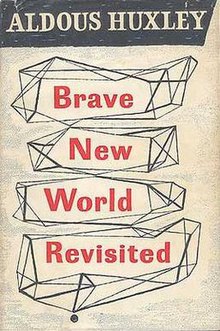
Brave New World Revisited (Harper & Brothers, US, 1958; Chatto & Windus, UK, 1959),[41] written by Huxley almost thirty years later Brave New World, is a non-fiction piece of work in which Huxley considered whether the world had moved toward or away from his vision of the time to come from the 1930s. He believed when he wrote the original novel that it was a reasonable approximate every bit to where the earth might go in the future. In Brave New World Revisited, he concluded that the world was condign similar Brave New World much faster than he originally thought.
Huxley analysed the causes of this, such as overpopulation, every bit well as all the means by which populations can exist controlled. He was particularly interested in the effects of drugs and subliminal proffer. Dauntless New World Revisited is different in tone because of Huxley'southward evolving thought, as well as his conversion to Hindu Vedanta in the acting betwixt the two books.
The concluding chapter of the book aims to propose action which could be taken to foreclose a democracy from turning into the totalitarian earth described in Brave New Earth. In Huxley's last novel, Island, he again expounds similar ideas to depict a utopian nation, which is generally viewed every bit a analogue to Brave New World.[ citation needed ]
Censorship [edit]
Co-ordinate to American Library Association, Dauntless New World has frequently been banned and challenged in the United States due to insensitivity, offensive linguistic communication, nudity, racism, disharmonize with a religious viewpoint, and existence sexually explicit.[42] It landed on the list of the height x most challenged books in 2010 (3) and 2011 (7).[42] The book besides secured a spot on the association's list of the top ane hundred challenged books for 1990-1999 (54),[5] 2000-2009 (36),[6] and 2010-2019 (26).[7]
The following include specific instances of when the volume has been censored, banned, or challenged:
- In 1932, the book was banned in Republic of ireland for its language, and for supposedly existence anti-family and anti-religion.[43] [44]
- In 1965, a Maryland English teacher alleged that he was fired for assigning Brave New Earth to students. The teacher sued for violation of Starting time Subpoena rights but lost both his instance and the appeal.[45]
- The book was banned in India in 1967, with Huxley accused of beingness a "pornographer".[46]
- In 1980, it was removed from classrooms in Miller, Missouri amidst other challenges.[47]
- The version of Brave New World Revisited published in Cathay lacks explicit mentions of Communist china itself.[48]
Influences and allegations of plagiarism [edit]
The English writer Rose Macaulay published What Not: A Prophetic Comedy in 1918. What Not depicts a dystopian future where people are ranked by intelligence, the authorities mandates mind training for all citizens, and procreation is regulated by the land.[49] Macaulay and Huxley shared the same literary circles and he attended her weekly literary salons.
George Orwell believed that Brave New World must have been partly derived from the 1921 novel Nosotros past Russian writer Yevgeny Zamyatin.[50] Yet, in a 1962 letter to Christopher Collins, Huxley says that he wrote Brave New World long before he had heard of We.[51] Co-ordinate to We translator Natasha Randall, Orwell believed that Huxley was lying.[52] Kurt Vonnegut said that in writing Player Piano (1952), he "cheerfully ripped off the plot of Brave New World, whose plot had been cheerfully ripped off from Yevgeny Zamyatin'due south We".[53]
In 1982, Shine author Antoni Smuszkiewicz, in his analysis of Polish science-fiction Zaczarowana gra ("The Magic Game"), presented accusations of plagiarism confronting Huxley. Smuszkiewicz showed similarities between Dauntless New World and 2 science fiction novels written earlier by Polish author Mieczysław Smolarski, namely Miasto światłości ("The Metropolis of Light", 1924) and Podróż poślubna pana Hamiltona ("Mr Hamilton's Honeymoon Trip", 1928).[54] Smuszkiewicz wrote in his open letter to Huxley: "This work of a keen author, both in the general delineation of the world too as countless details, is and then similar to two of my novels that in my opinion there is no possibility of accidental analogy."[55]
Kate Lohnes, writing for Encyclopædia Britannica, notes similarities between Dauntless New Globe and other novels of the era could be seen as expressing "common fears surrounding the rapid advocacy of technology and of the shared feelings of many tech-skeptics during the early on 20th century". Other dystopian novels followed Huxley's work, including Orwell's Nineteen Eighty-Four (1949).[56]
Legacy [edit]
In 1999, the Modern Library ranked Brave New Earth 5th on its list of the 100 best English-language novels of the 20th century.[2] In 2003, Robert McCrum writing for The Observer included Brave New World chronologically at number 53 in "the acme 100 greatest novels of all fourth dimension",[3] and the novel was listed at number 87 on the BBC's survey The Large Read.[4]
On 5 November 2019, the BBC News listed Brave New World on its list of the 100 most influential novels.[57]
Adaptations [edit]
Theatre [edit]
- Brave New World (opened iv September 2015) in co-production by Royal & Derngate, Northampton and Touring Consortium Theatre Company which toured the UK. The accommodation was by Dawn King, composed by These New Puritans and directed by James Dacre.
Radio [edit]
- Brave New World (radio circulate) CBS Radio Workshop (27 January and three February 1956): music composed and conducted by Bernard Herrmann. Adapted for radio by William Froug. Introduced by William Conrad and narrated by Aldous Huxley. Featuring the voices of Joseph Kearns, Beak Idelson, Gloria Henry, Charlotte Lawrence,[58] Byron Kane, Sam Edwards, Jack Kruschen, Vic Perrin, Lurene Tuttle, Herb Butterfield, Paul Hebert, Doris Singleton.[59]
- Brave New World (radio broadcast) BBC Radio4 (May 2013)
- Brave New Globe (radio broadcast) BBC Radio4 (22, 29 May 2016)
Motion-picture show [edit]
- Dauntless New World (1980), a goggle box film directed by Burt Brinckerhoff
- Brave New Earth (1998), a television film directed by Leslie Libman and Larry Williams
- In 2009 a theatrical film was announced to be in development, with collaboration between Ridley Scott and Leonardo DiCaprio.[lx] By May 2013 the project was placed on concur.[61]
Tv set [edit]
In May 2015, The Hollywood Reporter reported that Steven Spielberg's Amblin Television set would bring Brave New World to Syfy network as a scripted series, adapted by Les Bohem.[62] The adaptation was eventually written by David Wiener with Grant Morrison and Brian Taylor, with the series ordered to air on USA Network in February 2019.[63] The series eventually moved to the Peacock streaming service and premiered on 15 July 2020.[64] In October 2020, the series was canceled afterwards one season.[65]
See also [edit]
- The Abolitionism of Human
- Alpha (ethology)
- Anti-nationalism
- Anti-theism
- Canticle
- Bogus uterus
- Brain–computer interface
- Fetal alcohol spectrum disorder
- The Drinking glass Fortress (2016 film)
References [edit]
Citations [edit]
- ^ "Brave New World Book Details". fAR BookFinder . Retrieved 28 November 2016.
- ^ a b "100 Best Novels". Random House. 1999. Retrieved 23 June 2007. This ranking was by the Modern Library Editorial Board of authors.
- ^ a b McCrum, Robert (12 Oct 2003). "100 greatest novels of all fourth dimension". Guardian. London. Retrieved 10 October 2012.
- ^ a b "BBC – The Big Read". BBC. April 2003, Retrieved 26 Oct 2012
- ^ a b Office of Intellectual Freedom (26 March 2013). "100 most frequently challenged books: 1990-1999". American Library Association. Archived from the original on ten Oct 2020. Retrieved 17 June 2021.
- ^ a b Office of Intellectual Freedom (26 March 2013). "Top 100 Banned/Challenged Books: 2000-2009". American Library Association. Archived from the original on 24 September 2020. Retrieved 17 June 2021.
- ^ a b Office of Intellectual Liberty (nine September 2020). "Summit 100 Most Banned and Challenged Books: 2010-2019". American Library Association. Archived from the original on 27 September 2020. Retrieved 17 June 2021.
- ^ Anon. "Brave New World". In Our Fourth dimension. British Broadcasting Corporation. Retrieved 9 April 2009.
- ^ Bate, Jonathan; Rasmussen, Eric (2007). William Shakespeare: Complete Works. The Regal Shakespeare Visitor. Principal Associate Editor: Héloïse Sénéchal. Macmillan Publishers Ltd. p. 47. ISBN978-0-230-00350-7.
- ^ Ira Grushow (Oct 1962). "Brave New World and The Storm". College English. 24 (one): 42–45. doi:10.2307/373846. JSTOR 373846.
- ^ Martine de Gaudemar (1995). La Notion de nature chez Leibniz: colloque. Franz Steiner Verlag. p. 77. ISBN978-three-515-06631-0.
- ^ Meckier, Jerome (1979). "A Neglected Huxley "Preface": His Earliest Synopsis of Dauntless New World". Twentieth Century Literature. 25 (i): i–xx. doi:ten.2307/441397. ISSN 0041-462X. JSTOR 441397.
- ^ Murray, Nicholas (13 December 2003). "Nicholas Murray on his life of Huxley". The Guardian. ISSN 0261-3077. Retrieved 13 April 2020.
- ^ "A. Huxley in Sanary 1 - Introduction". www.sanary.com. Archived from the original on 11 January 2017. Retrieved 27 September 2019.
- ^ Huxley, Aldous (1969). "letter to Mrs. Kethevan Roberts, 18 May 1931". In Smith, Grover (ed.). Letters of Aldous Huxley. New York and Evanston: Harper & Row. p. 348.
I am writing a novel virtually the hereafter – on the horror of the Wellsian Utopia and a revolt against information technology. Very hard. I have hardly enough imagination to deal with such a subject field. But it is none the less interesting work.
- ^ Heje, Johan (2002). "Aldous Huxley". In Harris-Fain, Darren (ed.). British Fantasy and Science-Fiction Writers, 1918–1960. Detroit: Gale Group. p. 100. ISBN0-7876-5249-0.
- ^ Lawrence biographer Frances Wilson writes that "the entire novel is saturated in Lawrence" and cites "Lawrence'southward New Mexico" in particular. Wilson, Frances (2021). Burning Man: The Trials of D.H. Lawrence, New York: Farrar, Straus and Giroux, pp. 404-405.
- ^ Nathaniel Ward "The visions of Wells, Huxley and Orwell - why was the Twentieth Century impressed by Distopias rather than Utopias?" in Ophelia Ruddle (ed.) Proceedings of the 2003 Annual Multidisciplinary Round Table on Twentieth Century Culture"
- ^ Haldane, J.B.S. (1924). Daedalus; or, Science and the Future.
- ^ Dyson, Freeman (1976). Agonizing the Universe. Basic Books. Affiliate 15.
- ^ a b c Bradshaw, David (2004). "Introduction". In Huxley, Aldous (ed.). Dauntless New Earth (Print ed.). London, UK: Vintage.
- ^ Huxley, Aldous. Dauntless New World (Vintage Classics ed.). [ folio needed ]
- ^ Meckier, Jerome (2002). "Aldous Huxley'southward Americanization of the "Brave New World"" (PDF). Twentieth Century American Literature. 48 (4): 439. JSTOR 3176042. Retrieved xxx December 2021.
- ^ Huxley, Aldous (1932). Brave New World. New York: Harper & Brothers. p. 101. ISBN978-0-06-085052-4.
- ^ a b Huxley, Aldous (1932). Dauntless New Earth. New York: Harper & Brothers. p. 253. ISBN978-0-06-085052-4.
- ^ Huxley, Aldous (1932). Dauntless New Earth. New York: Harper & Brothers. p. 252. ISBN978-0-06-085052-4.
- ^ Huxley, Aldous (1932). Brave New Globe. New York: Harper & Brothers. p. 254. ISBN978-0-06-085052-4.
- ^ Her proper name is a in-joke reference to John Keate, the notorious 19th century flogging headmaster of Eton.
- ^ chapter 3, "Our Ford-or Our Freud, as, for some inscrutable reason, he chose to phone call himself whenever he spoke of psychological matters–Our Freud had been the first to reveal the appalling dangers of family life"
- ^ a b Naughton, John (22 November 2013). "Aldous Huxley: the prophet of our brave new digital dystopia | John Naughton". The Guardian . Retrieved 7 Oct 2018.
- ^ Meckier, Jerome (2006). "Onomastic Satire: Names and Naming in Dauntless New Earth". In Firchow, Peter Edgerly; Nugel, Bernfried (eds.). Aldous Huxley: mod satirical novelist of ideas. Lit Verlag. pp. 187ff. ISBN3-8258-9668-four. OCLC 71165436. Retrieved 28 January 2009.
- ^ The Daily Telegraph, 5 February 1932. Reprinted in Donald Watt, "Aldous Huxley: The Critical Heritage. London; Routledge, 2013 ISBN 1136209697 (pp. 197–201).
- ^ Scrutiny, May 1932 . Reprinted in Watt, (pp. 202–205).
- ^ The New Leader, 11 March 1932. Reprinted in Watt, (pp. 210–13).
- ^ Huxley, Aldous. Dauntless New World. Harper Perennial Modern Classics; Reprint edition (17 Oct 2006), P.Southward. Edition, ISBN 978-0-06-085052-4 — "Nigh the Book." — "Too Far Ahead of Its Time? The Contemporary Response to Brave New World (1932)" p. 8-11
- ^ Grand.Chiliad. Chesterton, review in The Illustrated London News, 4 May 1935
- ^ Ludwig von Mises (1944). Bureaucracy, New Oasis, CT: Yale University Press, p 110
- ^ a b "Letters of Note: 1984 v. Brave New World". 8 Feb 2020. Archived from the original on eight February 2020. Retrieved 8 Feb 2020.
- ^ Christopher Hitchens, "Cheerio to All That: Why Americans Are Not Taught History." Harper'southward Magazine. Nov 1998, pp. 37–47.
- ^ Huxley, Aldous (2005). Dauntless New World and Brave New Earth Revisited. Harper Perennial Modern Classics. p. 7. ISBN978-0060776091.
- ^ "Brave New World Revisited – HUXLEY, Aldous | Between the Covers Rare Books". Betweenthecovers.com. Archived from the original on nine June 2011. Retrieved 1 June 2010.
- ^ a b Function of Intellectual Liberty (26 March 2013). "Meridian 10 Nigh Challenged Books Lists". American Library Association. Archived from the original on 28 July 2017. Retrieved 17 June 2021.
- ^ "Banned Books". Classiclit.about.com. 2 November 2009. Retrieved one June 2010.
- ^ "Banned Books". pcc.edu. Archived from the original on two June 2010. Retrieved 11 June 2010.
- ^ Karolides, Nicholas J.; Bald, Margaret; Sova, Dawn B. (2011). 120 Banned Books: Censorship Histories of World Literature (Second ed.). Checkmark Books. p. 472. ISBN978-0-8160-8232-ii.
In 1965, a teacher of English in Maryland claimed that the local schoolhouse board had violated his Offset Amendment rights past firing him after he assigned Brave New World every bit a required reading in his form. The commune court ruled against the teacher in Parker 5. Board of Education, 237 F. Supp. 222 (D.Md) and refused his request for reinstatement in the teaching position. When the instance was later heard by the circuit court, Parker v. Board of Education, 348 F.2d 464 (fourth Cir. 1965), the presiding judge affirmed the ruling of the lower court and included in the determination the stance that the nontenured status of the teacher accounted for the firing and not the assignment of a particular book.
- ^ Sharma, Partap (1975). Razdan, C. Yard. (ed.). Bare breasts and Bare Bottoms: Anatomy of Film Censorship in India. Bombay: Jaico Publishing House. pp. 21–22.
- ^ Sakmann, Lindsay. "Lion: Banned Books Week: Banned BOOKS in the Library". library.albright.edu . Retrieved 18 June 2020.
- ^ Hawkins, Amy; Wasserstrom, Jeffrey (xiii January 2019). "Why 1984 Isn't Banned in China". The Atlantic . Retrieved 23 November 2021.
- ^ Livni, Ephrat (19 December 2018). "A woman first wrote the prescient ideas Huxley and Orwell fabricated famous". Quartz . Retrieved 28 October 2020.
- ^ Orwell, George (4 January 1946). "Review". Orwell Today. Tribune.
- ^ Russell, Robert (1999). Zamiatin'southward We. Bristol: Bristol Classical Press. p. 13. ISBN978-1-85399-393-0.
- ^ "Leonard Lopate Prove". WNYC. 18 August 2006. Archived from the original on 5 April 2011.
{{cite news}}: CS1 maint: bot: original URL status unknown (link) (radio interview with We translator Natasha Randall) - ^ Playboy interview with Kurt Vonnegut, Jr. Archived 10 February 2009 at the Wayback Machine, July 1973.
- ^ Smuszkiewicz, Antoni (1982). Zaczarowana gra: zarys dziejów polskiej fantastyki naukowej (in Polish). Poznań: Wydawn. Poznanskie. OCLC 251929765. [ page needed ]
- ^ "Nowiny Literackie" 1948 No. four, p seven
- ^ Kate Lohnes, Brave New Earth at the Encyclopædia Britannica
- ^ "100 'most inspiring' novels revealed by BBC Arts". BBC News. 5 November 2019. Retrieved ten November 2019.
The reveal kickstarts the BBC's year-long celebration of literature.
- ^ "Forgotten Actors: Charlotte Lawrence". Forgottenactors.blogspot.ca. four December 2012. Retrieved eleven August 2016.
- ^ Jones, Josh (20 Nov 2014). "Hear Aldous Huxley Read Brave New World. Plus 84 Classic Radio Dramas from CBS Radio Workshop (1956-57)". Open Culture. Retrieved xi Baronial 2016.
- ^ "Leonardo DiCaprio And Ridley Scott Squad for 'Brave New Globe' Adaptation". Filmofilia. 9 August 2009.
- ^ Weintraub, Steve "Frosty". "Ridley Scott Talks PROMETHEUS, Viral Advertising, TRIPOLI, the Blade RUNNER Sequel, PROMETHEUS Sequels, More, May 31, 2012". Collider.
- ^ Goldberg, Lesley (five May 2015). "Steven Spielberg's Amblin, Syfy Adapting Classic Novel 'Dauntless New Earth' (Exclusive)". The Hollywood Reporter.
- ^ Andreeva, Nellie (13 February 2019). "'Dauntless New World' Drama Based on Aldous Huxley Novel Moves From Syfy To USA With Serial Order". Deadline . Retrieved thirteen February 2019.
- ^ Andreeva, Nellie (17 September 2019). "NBCU Streamer Gets Name, Sets Slate of Reboots, 'Dr. Expiry', Ed Helms & Amber Ruffin Series, 'Parks & Rec'". Deadline . Retrieved 17 September 2019.
- ^ Andreeva, Nellie (28 October 2020). "'Brave New Earth' Canceled Past Peacock After Ane Season". Deadline. Archived from the original on 29 October 2020. Retrieved 31 Baronial 2021.
General bibliography [edit]
- Huxley, Aldous (1998). Brave New World (First Perennial Classics ed.). New York: HarperCollins Publishers. ISBN0-06-092987-one.
- Huxley, Aldous (2005). Brave New Earth and Brave New World Revisited (First Perennial Classics ed.). New York: HarperCollins Publishers. ISBN0-06-077609-9.
- Huxley, Aldous (2000). Brave New World Revisited (First Perennial Classics ed.). New York: HarperCollins Publishers. ISBN0-06-095551-one.
- Postman, Neil (1985). Agreeable Ourselves to Death: Public Discourse in the Age of Evidence Business. USA: Penguin United states of america. ISBN0-670-80454-ane.
- Higgins, Charles; Higgins, Regina (2000). Cliff Notes on Huxley's Brave New World. New York: Wiley Publishing. ISBN0-7645-8583-5.
- Russell, Robert (1999). Zamiatin's We. Bristol: Bristol Classical Press. ISBN978-one-85399-393-0.
External links [edit]
- Dauntless New World title listing at the Net Speculative Fiction Database
- Brave New World at Faded Folio (Canada)
- Dauntless New World Revisited at Faded Page (Canada)
- 1957 interview with Huxley equally he reflects on his life work and the significant of Dauntless New World
- Aldous Huxley: Bioethics and Reproductive Bug
- Aldous Huxley's Brave New World: BBC Radio 4 In Our Time discussion
- Literapedia page for Dauntless New Globe
- Brave New World? A Defence Of Paradise-Applied science, a critical assay by David Pearce (also available every bit a video recording)
- The Huxley Trap (The New York Times; 14 November 2018)
Source: https://en.wikipedia.org/wiki/Brave_New_World
0 Response to "This Brave New World Will Be Born Again"
Post a Comment