Which of the Following Can Diminish the Intensity of a Hurricane?
Hurricane Facts
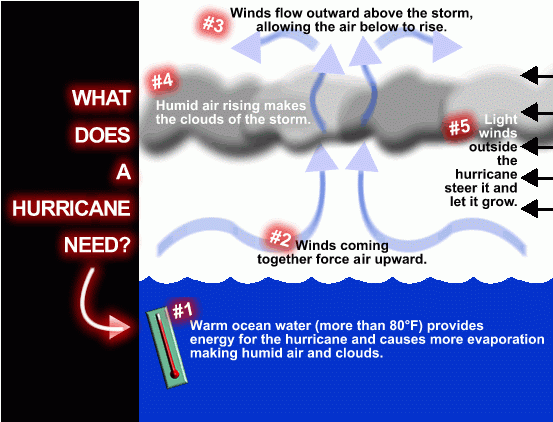
There are six widely accustomed conditions for hurricane development:
i. The start condition is that body of water waters must exist higher up 26 degrees Celsius (79 degrees Fahrenheit). Below this threshold temperature, hurricanes will non form or volition weaken quickly in one case they move over h2o below this threshold. Ocean temperatures in the tropical East Pacific and the tropical Atlantic routinely surpass this threshold.
2. The second ingredient is altitude from the equator. Without the spin of the earth and the resulting Corioles forcefulness, hurricanes would not form. Since the Corioles force is at a maximum at the poles and a minimum at the equator, hurricanes can not form within v degrees latitude of the equator. The Corioles force generates a counterclockwise spin to low pressure level in the Northern Hemisphere and a clockwise spin to low pressure in the Southern Hemisphere.
3. The 3rd ingredient is that of a saturated lapse rate gradient virtually the center of rotation of the storm. A saturated lapse charge per unit insures latent oestrus will be released at a maximum rate. Hurricanes are warm core storms. The heat hurricanes generate is from the condensation of water vapor as it convectively rises around the center wall. The lapse charge per unit must be unstable effectually the eyewall to insure rising parcels of air will go along to rising and condense water vapor.
4. The fourth and one of the most important ingredients is that of a low vertical wind shear, especially in the upper level of the atmosphere. Air current shear is a alter in wind speed with height. Strong upper level winds destroy the storms construction past displacing the warm temperatures above the eye and limiting the vertical accent of air parcels. Hurricanes will non form when the upper level winds are likewise potent.
5. The fifth ingredient is high relative humidity values from the surface to the mid levels of the atmosphere. Dry air in the mid levels of the atmosphere impedes hurricane development in two means. First, dry air causes evaporation of liquid water. Since evaporation is a cooling process, it reduces the warm cadre structure of the hurricane and limits vertical development of convection. Second, dry air in the mid levels tin create what is known as a trade current of air inversion. This inversion is similar to sinking air in a high pressure system. The trade wind inversion produces a layer of warm temperatures and dryness in the mid levels of the temper due to the sinking and adiabatic warming of the mid level air. This inhibits deep convection and produces a stable lapse charge per unit.
6. The sixth ingredient is that of a tropical wave. Often hurricanes in the Atlantic begin as a thunderstorm complex that moves off the declension of Africa. It becomes what is known as a midtropospheric wave. If this wave encounters favorable weather such as stated in the start five ingredients, it will dilate and evolve into a tropical tempest or hurricane. Hurricanes in the East Pacific can develop by a midtropospheric wave or by what is known as a monsoonal trough.
Boosted items...
Source: https://www.weather.gov/source/zhu/ZHU_Training_Page/tropical_stuff/hurricane_anatomy/hurricane_anatomy.html
0 Response to "Which of the Following Can Diminish the Intensity of a Hurricane?"
Post a Comment